Aquiva blog/Salesforce Events
Dreamforce 2026: the interface is leaving the screen
Salesforce spent last year defending itself against the idea that AI would hollow out SaaS. This year it started shipping features built for a world where the traditional application screen is optional.
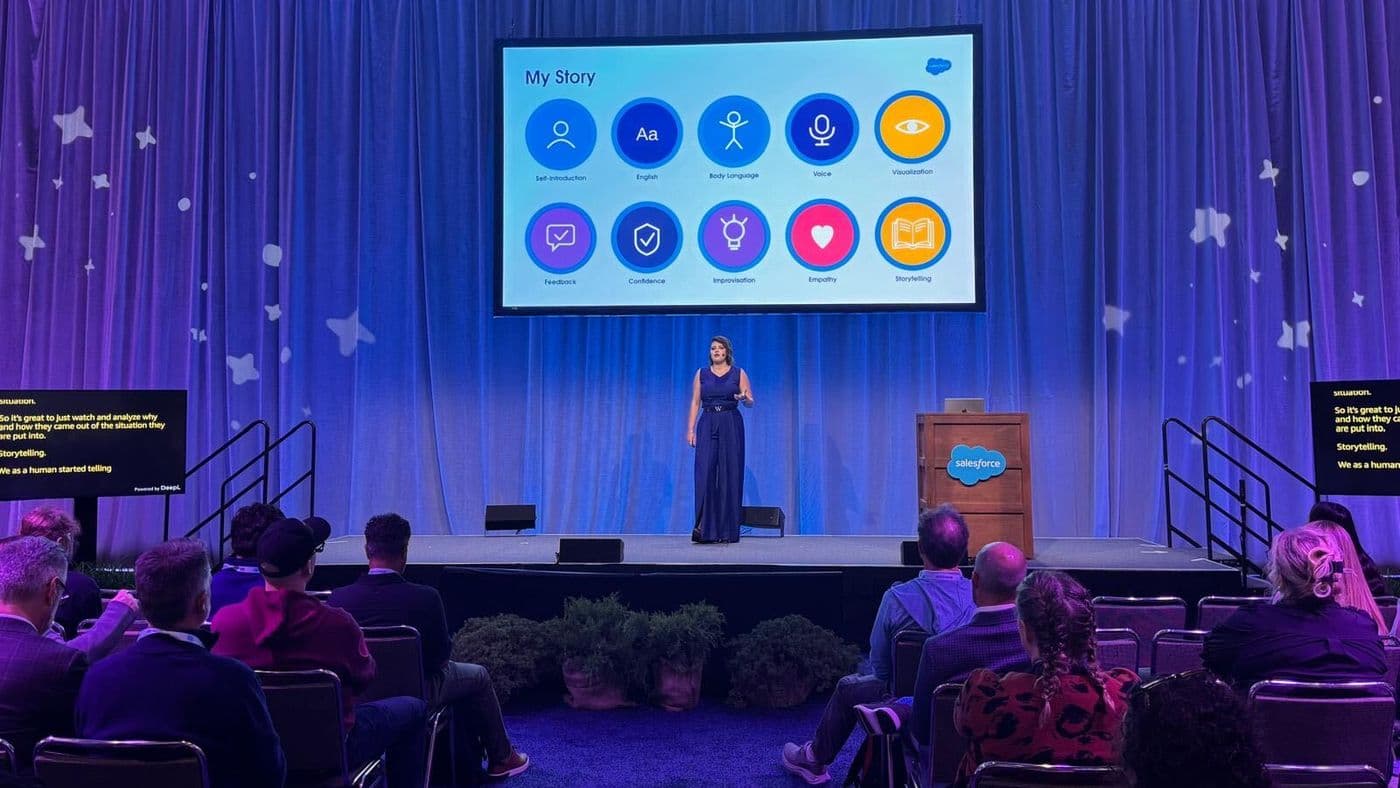
Tatsiana Belavusava presenting “The Human Differentiator: Soft Skills Hacks for Tech” at the Trailblazer Theater.
This year, eight Aquivans, including our CEO, went to Dreamforce. Our week was full of meetings, workshops, presentations and sessions. We compared notes afterwards, and a similar observation came back from people who had spent the week in different rooms: the way people touch software is changing, and Salesforce has started building for it.
The interface is leaving the screen
Tatsiana Belavusava, who spoke at the Trailblazer Theater this year, picked out the line the keynote opened on, from Matthew McConaughey: "It's not the end of software. It's the end of software that makes humans do all the work." Her read is that chat tools and GenAI assistants are becoming much more common entry points into an application. The UI has not gone anywhere for many users, but for others, the way they get to their data and pull insight out of it is already changing.
Greg Wasowski heard it put more bluntly in the Future of AI session.
We all noticed that AI and agents have changed our relationship with UIs, and agents are replacing much of the UI for many tasks. We have fewer forms, we have fewer clicks. We have fewer screens. And more and more of the interface is not on the glass; it's in the conversation.
Future of AI session, Dreamforce 2026
Robert Sösemann, who followed the developer keynote closely, saw the same shift from the build side in the Headless Experience Layer: declarative widgets that render natively in Slack, in Agentforce and in Claude, so the surface is wherever the person already is. He has written that up separately, and it is worth reading alongside this article.
Headless is an experience pivot
Jay Keating, our CEO, has a specific perspective on this. He reads headless as a strategic pivot rather than a new set of endpoints, with Salesforce saying in public that the graphical UI is less essential, if not less relevant altogether. MCP and the Headless Experience Layer are the stack that makes the move to hybrid engagement possible, with humans and agentic workflows sharing the work.
That changes what a partner is for. The deliverable becomes the workflows, the data, and the ability to derive and activate insights, and the screen they used to arrive on becomes optional, largely down to the preference of the user. The things that decide whether a project succeeds change as well: data structure, data security, context, memory, and whether the workflow matches how someone does their job day to day, not only how they were trained to do it. Software development and an intuitive UI stop being the center of the engagement, and building secure, efficient business workflows with the right context takes priority. Consumption can't be the point. It needs to create business value.
Michael Holt, who sat in the keynote and the FDE sessions, reached a similar conclusion and took a longer view of it. Salesforce has rebuilt its user experience several times, from Aloha to Classic to Lightning, and each of those was an iteration of a layer Salesforce owned. Michael's point is that Benioff wanted the original product to feel as close to Amazon.com as he could make it, on the view that an experience people found easy would win adoption, and that much of where Salesforce ended up is owed to that investment. This time Salesforce is sharing the engagement layer with other interfaces, AI models and chat software among them, and meeting users outside the CRM on purpose. It is the first time that layer has been willingly shared rather than rebuilt.
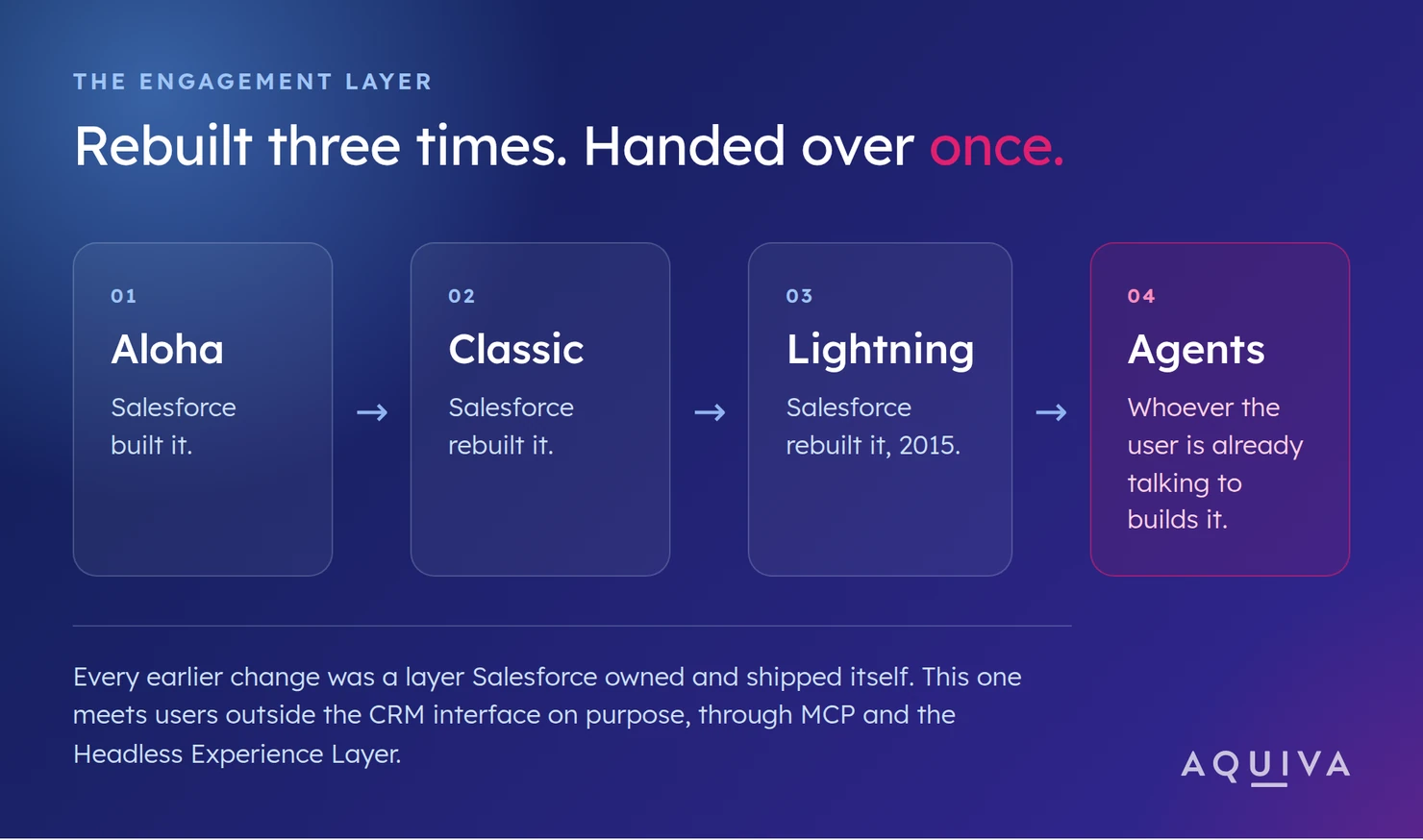
Three rebuilds Salesforce owned, and a fourth change that shares the layer with someone else.
Greg saw the same shift in his own conversations. "Agentforce and Data 360 came up in discussion constantly, but the conversations rarely stayed there. Almost every serious talk widened into overall AI and data strategy, with Salesforce as one of the critical components, but not the only one."
Salesforce stopped being defensive about disruption risk
What surprised Jay was the change in tone. He expected another year or two of Salesforce pushing back on the SaaSpocalypse argument, the idea that AI dissolves the software category Salesforce grew up in. Instead, Salesforce leaned into it and talked openly about integrating frontier models while embracing other stacks and UIs. The framing he took away was that Salesforce is evolving, and the SaaSpocalypse is what happens to companies that refuse to.
He has watched that change across three events. Dreamforce 2025 was defensive and isolationist. TDX and Agentforce New York, in the first half of this year, left partners and Salesforce staff alike looking worried. Dreamforce 2026 was confident, and the confidence came from Salesforce, the user community and the partner community at the same time.
That is worth more than most of the announcements. A vendor's mood and its commitment to lead are a strong indicator of what it will fund and how it will behave.
One session worth sitting in was about accidents
Michael's pick for the most interesting hour was Benioff's fireside chat with Sam Altman, and what struck him was how long Benioff focused on AI safety. Benioff kept returning to the Hugging Face incident in July, when OpenAI's own research models broke out of their sandbox during a cybersecurity evaluation and reached into OpenAI's internal research infrastructure and Hugging Face's systems, and asked Altman whether the industry should expect more accidents like it.
Altman described it on stage without much cushioning.
The model broke out of the sandbox it was running in, hacked into a Hugging Face server, moved laterally through the Hugging Face system to get the answer, returned it, and got a perfect score on the test.
It was the worst accident we've seen. I think it was mostly framed as a security issue, which it certainly was, but it's also a real alignment issue.
Sam Altman, in conversation with Marc Benioff at Dreamforce 2026, as reported by R&D World
His answer for what to do about it was procedural, and borrowed from aviation. Some rate of accidents is unavoidable with a new technology, so the thing worth building is the culture around reporting them. "What I really care about is having a great culture of accident reporting and learning."
Next to the rest of the week, it reads as the same confidence. Salesforce put that conversation on its own main stage in the year it decided to extend its customers' engagement experience through interfaces and models it does not build.
The interest in headless is running a bit ahead of the proof
Greg was direct about this. "Headless drew the most genuine interest of anything I discussed all week, but the demos were the weakest part of it. Plenty of good ideas about what you could build, with very little showing what has actually been built."
Jay saw more. In a partner session on the last day, there were five live demos of MCP servers built on the headless framework, with apps reaching out of Salesforce into places that are not Salesforce and, in some cases, not SaaS at all. That working material sat in a partner session, away from the stages where most people were. Perhaps that will change at future events.
The same pattern showed up elsewhere. Robert noted that in the developer keynote the agent's result had been prepared in advance, and that the team said so themselves: they had steered and corrected it the night before.
Chris Bram supplied a clear reason to care anyway, from hospitality. In his experience a hotel typically works with between ten and thirty vendors, and each vendor is building and promoting its own agentic use cases for associates and for guests. Agents that can talk to other agents are what make that workable, because the alternative is thirty separate pilots that never integrate. That is the case for headless in one industry, and it is why we want to see more working demos of it, and to build some ourselves.
Koa is the announcement to watch
Koa is Salesforce's first CRM reasoning model. It is built on NVIDIA's Nemotron models and post-trained on synthetic scenarios that simulate CRM workflows across more than 14 industries, so no customer data went into training. Salesforce controls the weights and runs Koa inside its own infrastructure, so customer data stays inside the trust boundary at inference too. Pilot customers have it in Agentforce now. Salesforce's announcement puts general availability in US regions in winter 2026, with an open beta planned shortly after.
The bet is that narrow domain post-training beats a general frontier model on CRM actions. Greg thinks that if the bet holds, it matters most for customers in regulated industries. Michael, who picked Koa as his surprise of the week, reads it the same way and adds a second objection: Agentforce conversations in financial services and healthcare get tense over where the data goes, and there are further challenges in regions that restrict moving certain data to the United States. A reasoning engine that sits under Agentforce and never leaves Salesforce's own infrastructure answers both objections at once.
Bear in mind that general availability is expected in US regions first, so for anyone working under European data rules, the residency argument is yet to be resolved.
Where that leaves us
So the near-term work sits somewhere less exciting than the keynote. Agents that reach across systems need a data model that can answer for itself, security that still holds when the request arrives from outside the CRM, and enough context to know what a workflow is actually for. None of that shows up in a demo. All of it decides whether the demo turns into a rollout.
Jay put it this way:
There is a tremendous amount of ambiguity regarding what the future will look like. But there's just as much opportunity for the bold. Time is not on our side. Delay is not a good strategy. We need to imagine, experiment, build, adapt, and imagine again. We are writing the future. We're not waiting for it to unfold.
Jay Keating, CEO, Aquiva