Aquiva blog/ISV / AppExchange
Heroku Enterprise End of Sale: Sustaining Mode Now, No End-of-Life Date Yet
Heroku Enterprise is end of sale and the platform has run in sustaining mode since February 6, 2026, with no end-of-life date set. What that means for AppExchange partners and Salesforce customers.
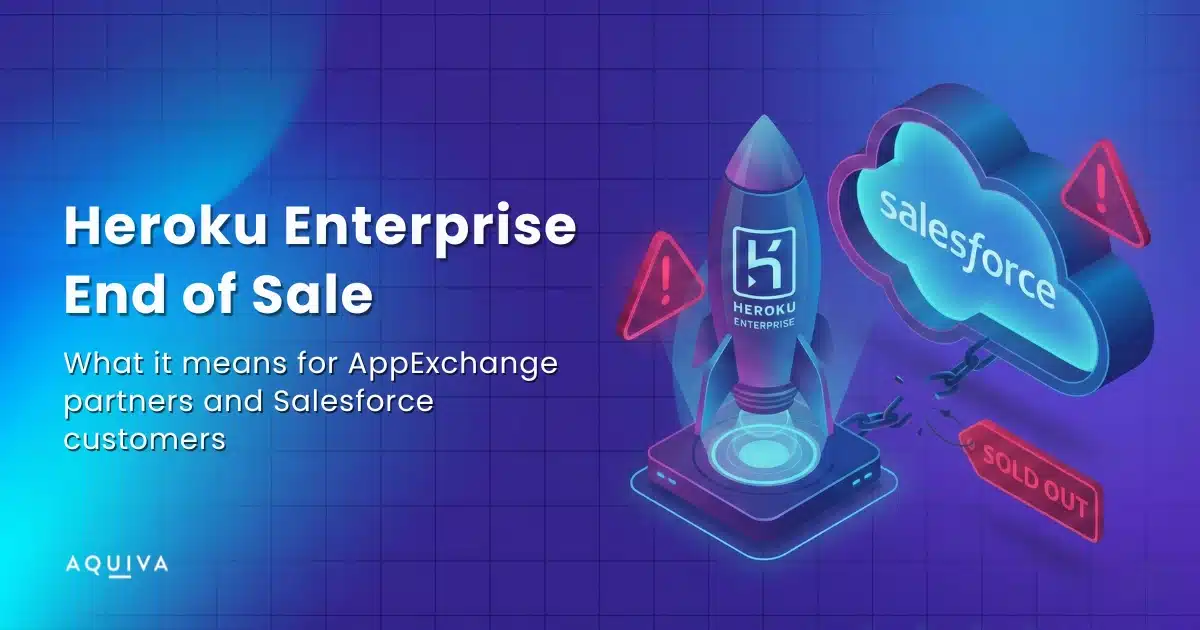
Salesforce has announced that Heroku Enterprise is now End of Sale (EOS) for new enterprise customers. The platform will no longer receive new license sales, though existing customers can typically continue using, renewing, and receiving support for a defined period.
End of Sale vs. End of Life: an important distinction
End of Sale (EOS) prevents new enterprise license sales to new customers, but existing customers retain usage rights, renewal options, and support access.
End of Life (EOL) is a more definitive milestone where products stop receiving updates, patches, or official support, potentially leading to full decommissioning.
Heroku announced a transition to a "sustaining engineering model" on February 6th, 2026. While no official End of Life date has been set, historical patterns suggest a 4–5 year wind-down. When Salesforce ended CPQ sales in March 2025, observers anticipated sunsetting around 2029–2030, with customer support maintained during the transition window.
Why this happened
Heroku revolutionized deployment through "git push to deploy" but didn't evolve with modern infrastructure expectations. Enterprise customers increasingly demanded containerization, Kubernetes support, serverless capabilities, and cost-effective maintenance, and those were the areas where Heroku consistently underperformed relative to competitive offerings.
What this means for AppExchange ISV partners
Partners running managed package backends on Heroku face several considerations:
- Backend infrastructure runs on a declining platform with diminishing talent and investment
- Heroku Connect, essential for bidirectional Salesforce data synchronization, is strategically uncertain even though no separate EOL announcement has been made
- Security evaluations by enterprise customers increasingly treat sunsetting platforms as a risk factor in procurement reviews
- Running applications on platforms with uncertain futures can negatively impact deal closure
What this means for Salesforce enterprise customers
Organizations using Heroku for custom applications, customer-facing portals, internal tools, or data integration layers should start migration planning now. A phased approach looks like:
- Technical assessment of current architecture
- Detailed migration planning
- Pilot migration of non-critical applications
- Production cutover
Enterprises depending on Heroku Connect for CRM synchronization need particular attention, since rebuilding integration layers demands careful planning to prevent downtime or data loss.
Cloud alternatives worth evaluating
Amazon Web Services (AWS) dominates cloud infrastructure through Elastic Beanstalk, ECS, and Lambda. AWS offers maximum flexibility but requires significant engineering resources to run the stack.
Microsoft Azure suits organizations invested in the Microsoft ecosystem. Azure App Service provides a PaaS experience comparable to Heroku, with mature enterprise security integration and Active Directory compatibility.
Google Cloud Platform (GCP) offers Cloud Run and Google Kubernetes Engine (GKE). Cloud Run provides container-based deployment with more flexibility than Heroku while maintaining familiar workflows. GCP typically provides competitive pricing for compute-intensive workloads.
Platform selection depends on architecture requirements, team capabilities, compliance obligations, and existing technology investments.
How Aquiva Labs can help
We provide end-to-end support for Heroku transitions:
Discovery and advisory. Technical assessments of current Heroku architecture, Salesforce integration requirements, and platform recommendations based on practical multi-cloud experience.
Migration planning and execution. Infrastructure setup, data synchronization redesign, CI/CD pipeline configuration, security hardening, and team collaboration to minimize operational disruption.
Ongoing managed engineering. Post-migration support for infrastructure stability, scaling, and sustained Salesforce integration robustness.
Don't wait for the official end-of-life date
Official End of Life announcements typically arrive after optimal migration windows close and experienced engineering talent becomes harder to find. Proactive planning today prevents reactive crisis management tomorrow. Early discovery engagements establish clear migration roadmaps aligned with your timelines and priorities.
Heroku end of sale: quick answers
Is Heroku shutting down?
Not today, and nobody has said when. On February 6, 2026, Heroku moved to a sustaining engineering model: the platform keeps running with security, reliability, and support work, and new features stop. Enterprise Account contracts are no longer sold to new customers, existing Enterprise subscriptions continue and can renew, and self-serve customers paying by card see no change to pricing or service. That is end of sale. End of life is a separate step, and Salesforce has not scheduled it.
What is the difference between Heroku End of Sale and End of Life?
End of sale stops new enterprise licenses. Existing customers keep their usage rights, renewal options, and support. End of life is when a product stops receiving updates, patches, and official support, which can finish in decommissioning. Heroku Enterprise has reached the first milestone and not the second, and the gap between them is the migration window.
When will Heroku reach end of life?
As of September 2026, no date has been announced. Our working estimate is a four-to-five-year wind-down, the same shape Salesforce gave CPQ after its March 2025 end of sale, which would put a Heroku sunset somewhere around 2030. Treat that as an estimate and plan as if the window is shorter. Individual stack versions do carry hard dates and are easy to confuse with the platform's: the Heroku-22 stack reaches end of life on April 30, 2027, after which apps on it keep running but can no longer be built or deployed, while Heroku-24 and Heroku-26 stay supported.
What does Heroku's sustaining engineering model mean in practice?
Heroku's own wording is a focus on "stability, security, reliability, and support", with quality and operations taking priority over new features. For a team running production on it, the platform is safe to keep using for now and will not close the gaps that pushed enterprises elsewhere: containers, Kubernetes, serverless, and cost control. The talent pool and the third-party ecosystem shrink from here, and enterprise security reviews have begun to list a sunsetting platform as a procurement risk.
What happens to Heroku Connect?
Salesforce has not announced a separate end of life for Heroku Connect, and it keeps working under the sustaining model. Its future is tied to the platform's. Anyone using it as the bidirectional sync between Salesforce and Heroku Postgres should treat that integration layer as the first thing to redesign in a migration, because rebuilding a live CRM sync is where downtime and data loss happen when the planning is thin.
Where do Heroku apps go?
To one of the hyperscalers, each of which has a service shaped like a PaaS: Elastic Beanstalk, ECS, or Lambda on AWS; App Service on Azure; Cloud Run or GKE on Google Cloud. The choice turns on architecture, the team's skills, compliance obligations, and where the rest of the stack already lives. The migration itself runs in four steps: a technical assessment, a migration plan, a pilot on a non-critical app, then production cutover.